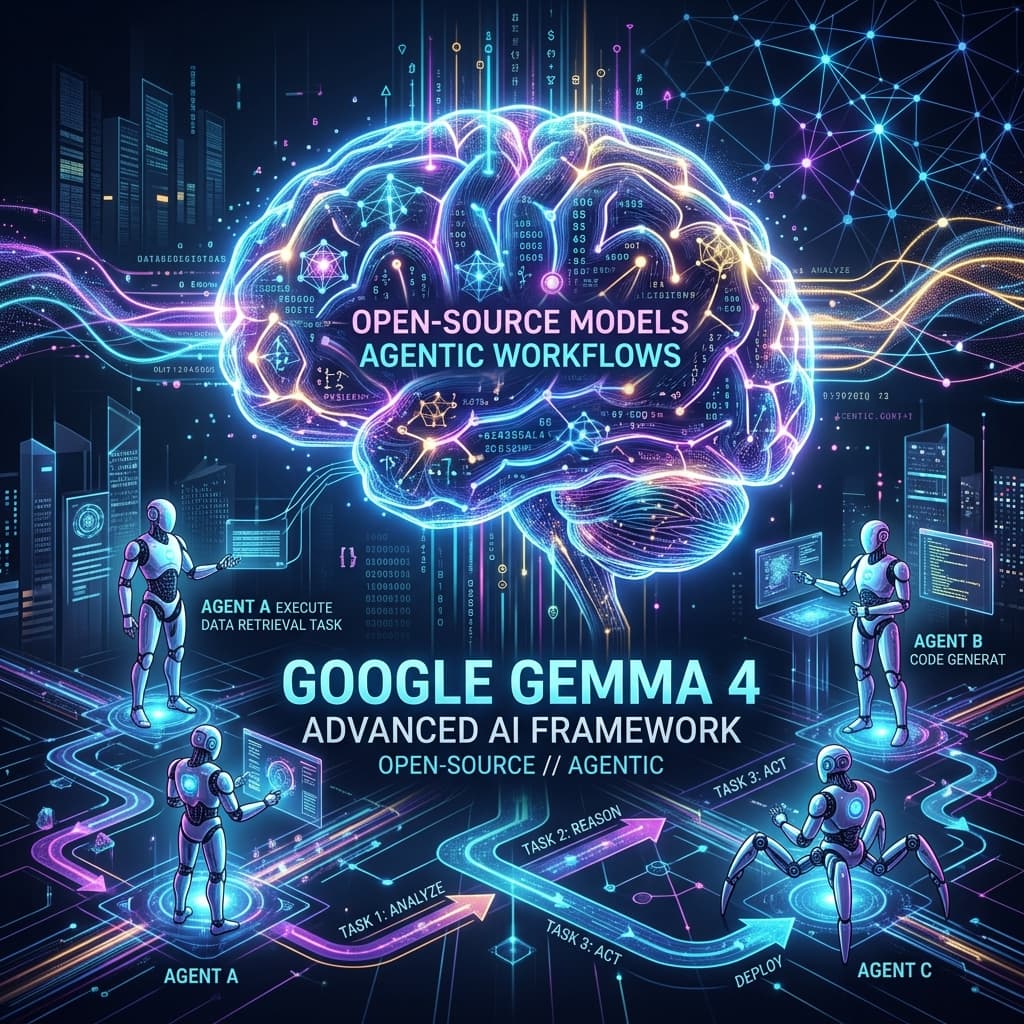


The right question in Q2 2026 is no longer, "Which model is smartest?" The real question is, which model fits the operating environment you actually have to support?
Google's Gemma 4, Moonshot AI's KIMI K 2.6, and Alibaba's Qwen 3.6 are all credible answers for agentic systems, long-context work, and multimodal workflows. But they win for very different reasons. Gemma 4 is strongest when control, privacy, and local deployment matter. KIMI K 2.6 is strongest when your workflow centers on productivity, documents, and coordinated agent behavior. Qwen 3.6 is strongest when scale, context length, and enterprise reliability dominate the decision.
This guide compares them from the perspective that matters most in real delivery work: architecture, agent workflows, context handling, multimodal behavior, deployment economics, and practical selection by workload.
1. The Short Version
If you only need the executive summary, start here.
| Model | Best Fit | Why Teams Pick It | Main Constraint |
|---|---|---|---|
| Gemma 4 | Private local inference, developer tooling, customizable agents | Open weights, strong local story, practical multimodal family, good efficiency | You own deployment quality, hardware sizing, and orchestration |
| KIMI K 2.6 | Research, office automation, document-heavy productivity workflows | Strong document understanding, agent-swarm narrative, visual coding appeal | Less control than self-hosted open-weight stacks |
| Qwen 3.6 | Large enterprise automation, extreme context, high-stakes multi-step reasoning | Massive context window, mature enterprise positioning, robust tool use | Cloud-centric economics and less local flexibility |
Fast Recommendation
- Pick Gemma 4 if data residency, self-hosting, or model adaptation are hard requirements.
- Pick KIMI K 2.6 if your highest-value workflows revolve around Word, Excel, PDF, dashboards, and multi-step productivity automation.
- Pick Qwen 3.6 if you need one model to absorb extremely large working sets and power expensive enterprise workflows with fewer orchestration compromises.
2. Architectural Positioning
The three models are not just different sizes. They represent three different product philosophies.
Gemma 4: Flexible Open-Weight Infrastructure
As of Q2 2026, Gemma 4 is best understood as a model family for teams that want control. It is open-weight, multimodal, and deployable across a wide spread of hardware tiers.
- Variants: E2B, E4B, 26B MoE, and 31B Dense.
- Core strength: Local and self-hosted deployment without giving up modern reasoning or multimodal patterns.
- What it enables: Private code assistants, on-prem document agents, edge inference, and domain adaptation through methods such as QLoRA.
Gemma 4 is attractive because it narrows the gap between lightweight local models and the kind of planning-heavy systems teams used to reserve for premium hosted APIs.
KIMI K 2.6: Productivity-Centric Agent Platform
KIMI K 2.6 is positioned less like a raw model and more like a productivity operating layer. Its public narrative centers on agent swarms, document-native work, and user-facing automation.
- Variants: Typically accessed as a managed capability rather than a classic open-weight family.
- Core strength: Coordinating multi-step tasks across documents, structured business files, and visual interfaces.
- What it enables: Research copilots, spreadsheet analysis, report generation, and workflows where multiple sub-tasks benefit from parallel reasoning.
KIMI is compelling when you want more than text completion. It is strongest when the model must operate like a high-output knowledge worker.
Qwen 3.6: Enterprise-Scale Reasoning Backbone
Qwen 3.6 is the most enterprise-oriented of the three. Its positioning emphasizes high context capacity, robust tool calling, and reasoning that remains stable under heavier workflow pressure.
- Variants: Premium managed configurations such as plus and max-style tiers.
- Core strength: Very large working memory, deep multi-step execution, and cloud-scale operational posture.
- What it enables: Enterprise automation, large-repository analysis, compliance-heavy workflows, and tasks where orchestration failure is expensive.
If Gemma is the flexible engineering stack and KIMI is the productivity engine, Qwen is the enterprise platform model.
3. Context Windows and Reasoning Depth
Context length matters, but teams still overrate it. A bigger window is useful only when the model can remain coherent, selective, and grounded inside it.
| Feature | Gemma 4 | KIMI K 2.6 | Qwen 3.6 |
|---|---|---|---|
| Max Context Window | Up to 256K tokens | 200K+ tokens | Up to 1M tokens |
| Reasoning Style | Explicit, task-oriented, prompt-steerable | Coordinated, agent-like, workflow-centric | Persistent deep reasoning with enterprise bias |
| Where It Feels Strongest | Codebases, manuals, local corpora | Documents, spreadsheets, research packets | Large repositories, audit trails, multi-source enterprise records |
What the Numbers Actually Mean
- Gemma 4 gives you enough context for many real-world local tasks: long reports, multi-file code review, manuals, policy packs, and retrieval-light agent workflows.
- KIMI K 2.6 is less about headline window size and more about how well it can work through complex human documents and mixed-format business artifacts.
- Qwen 3.6 is the context leader. If your workflow truly benefits from million-token working sets, it is the most natural fit.
The More Important Distinction
Do not confuse large context with good knowledge architecture.
- If the knowledge changes often, use RAG even if the context window is large.
- If the task is highly procedural, prioritize tool reliability and planning quality over raw context.
- If the workload is local and sensitive, the best decision is often the model you can run privately, not the model with the largest advertised limit.
4. Agentic Workflows and Tool Calling
All three models are viable for agent systems, but they encourage different system designs.
Gemma 4: Best for Developer-Controlled Agents
Gemma 4 is a strong choice when your engineering team wants to own the orchestration layer.
It works well through local runtimes such as Ollama and LM Studio, and it fits naturally into OpenAI-compatible tooling. That makes it practical for:
- Local file-system agents
- Codebase-aware assistants in VS Code
- Structured JSON workflows
- On-prem internal copilots for regulated data
Gemma is rarely the easiest out of the box, but it is often the most attractive over time because the surrounding system is yours.
KIMI K 2.6: Best for Coordinated Knowledge Work
KIMI's strongest story is not merely function calling. It is task coordination.
If your workflow sounds like, "read this workbook, compare it to these notes, search a few sources, then draft a clean brief," KIMI K 2.6 is well aligned with that pattern. Its appeal is highest when users want the system to behave like a compound assistant rather than a single-turn model endpoint.
That makes it compelling for:
- Research automation
- Analyst support
- Report generation from spreadsheets and PDFs
- Workflow chains where multiple subtasks can be delegated
Qwen 3.6: Best for High-Stakes Multi-Step Execution
Qwen 3.6 is strongest when failure is expensive and workflows are long.
If the job involves many tool calls, complex business rules, large evidence sets, and strict enterprise controls, Qwen's reasoning depth and cloud posture are advantages. It is a better fit for:
- Financial operations
- Compliance review systems
- Supply-chain coordination
- Enterprise approval and decision-support pipelines
Practical Agent Verdict
| If You Need... | Best Choice |
|---|---|
| Full control over prompts, policies, hosting, and integration | Gemma 4 |
| Document-centric multi-agent productivity workflows | KIMI K 2.6 |
| Long, costly, enterprise-grade automations | Qwen 3.6 |
5. Multimodal and Visual Capability
The quality of multimodal work depends on more than whether the model technically accepts images.
Gemma 4
Gemma 4 is the most interesting when you care about multimodality under local control.
- Strong fit for edge or private environments
- Useful for multimodal assistants that must stay close to the device or enterprise boundary
- Attractive for teams building custom pipelines around image, text, and sometimes richer media inputs
KIMI K 2.6
KIMI K 2.6 appears strongest in document vision and visual productivity.
- Reads charts, tables, visual layouts, and business documents naturally
- Appeals to teams that want "look at this artifact and do the work" experiences
- Strong candidate for UI-to-code and productivity assistant workflows
Qwen 3.6
Qwen 3.6 is best viewed as an enterprise document intelligence model.
- Strong for extracting structured signals from messy documents
- Useful when visual tasks are part of larger regulated workflows
- Better for operational document processing than consumer-style creative multimodality
Bottom Line on Multimodality
- Choose Gemma 4 for private multimodal systems and local experimentation.
- Choose KIMI K 2.6 for document-heavy productivity and visual workbench scenarios.
- Choose Qwen 3.6 for enterprise visual extraction and large operational document pipelines.
6. Deployment, Governance, and Economics
This is where most final decisions are actually made.
| Criterion | Gemma 4 | KIMI K 2.6 | Qwen 3.6 |
|---|---|---|---|
| Deployment Model | Open weights, local or self-hosted | Managed platform / hosted experience | Managed cloud / enterprise services |
| Hardware Profile | Smaller variants run on modest local hardware; larger ones still need meaningful VRAM | No local GPU requirement for typical use | No local GPU requirement for standard adoption |
| Data Control | Highest control | Moderate control via provider terms | Enterprise governance posture |
| Cost Shape | Upfront infrastructure cost, lower marginal usage cost | Usage-based operating cost | Enterprise-scale usage cost with premium reliability |
| Customization | Highest | Lower | Moderate within managed boundaries |
The Real Economic Tradeoff
Gemma 4 looks cheaper when:
- usage volume is high,
- data cannot leave your environment,
- and your team can operate the stack competently.
KIMI K 2.6 looks cheaper when:
- you need fast time-to-value,
- your workflows revolve around knowledge work,
- and productivity gains matter more than deep platform control.
Qwen 3.6 looks cheaper when:
- the business value of each workflow is high,
- orchestration failure is costly,
- and cloud governance is acceptable.
Governance Rule of Thumb
If your data cannot cross a hard boundary, the conversation narrows quickly. In that case, Gemma 4 is usually the most realistic path of the three.
7. Which Model Wins by Use Case?
This is the section most teams should use when shortlisting.
| Use Case | Best Starting Choice | Why |
|---|---|---|
| Private code assistant in VS Code | Gemma 4 | Open-weight local deployment is the deciding factor |
| Spreadsheet and PDF-heavy research automation | KIMI K 2.6 | Document-native workflow fit |
| Large enterprise knowledge agent | Qwen 3.6 | Context scale plus operational posture |
| Edge or device-side multimodal app | Gemma 4 | Better local deployment story |
| Visual coding from product mockups | KIMI K 2.6 | Stronger visual-productivity positioning |
| Compliance-heavy automation with many system calls | Qwen 3.6 | Higher confidence for high-stakes multi-step reasoning |
| Custom fine-tuned domain assistant | Gemma 4 | Best path for adaptation and self-hosting |
8. Common Selection Mistakes
Teams evaluating these models often make the same three mistakes.
Mistake 1: Buying the Biggest Context Window Without a Retrieval Strategy
A 1M-token window is impressive, but it does not eliminate the need for indexing, retrieval, ranking, and evidence control. Large context is a capability, not an architecture.
Mistake 2: Treating "Agentic" as a Single Capability
Gemma, KIMI, and Qwen all support agentic patterns, but not in the same way.
- Gemma favors developer-built orchestration.
- KIMI favors workflow coordination and user productivity.
- Qwen favors enterprise-grade multi-step execution.
Mistake 3: Ignoring the Operating Model
If your team does not want to manage hosting, quantization, model routing, and observability, an open-weight model can become an operational burden instead of a strategic win.
9. A Practical Decision Framework
Use these questions in order.
1. Does the model need to run privately or on-prem?
If yes, start with Gemma 4.
2. Is the workload primarily document-centric knowledge work?
If yes, shortlist KIMI K 2.6 first.
3. Do you need an extreme context window and enterprise workflow reliability?
If yes, Qwen 3.6 should move to the front.
4. Do you want to fine-tune, customize deeply, or embed the model into proprietary systems you fully control?
Again, that points back to Gemma 4.
5. Is your primary KPI analyst throughput rather than infrastructure ownership?
That usually points to KIMI K 2.6.
6. Is each workflow expensive enough that cloud premium is justified by reduced failure risk?
That is where Qwen 3.6 becomes easier to defend.
Conclusion
There is no universal winner here, because these models are solving different business problems.
Gemma 4 is the best fit for teams that want private inference, open-weight flexibility, local deployment, and long-term control over the full stack.
KIMI K 2.6 is the best fit for teams that want a highly productive, document-aware, workflow-centric assistant without building every layer themselves.
Qwen 3.6 is the best fit for organizations that need very large context, strong tool use, and enterprise-grade reasoning in costly, multi-step environments.
If you are choosing among them, stop comparing them as abstract intelligence benchmarks. Compare them by deployment model, data boundary, workflow shape, and cost of failure. That is where the real winner becomes obvious.
Building something in ai & machine learning?
Our AI & Data team ships production-grade systems like this. Free 30-min consultation.
Subscribe
Get our best insights in your inbox
Practical guides on AI, cloud, security, and marketing. No spam, unsubscribe in one click.