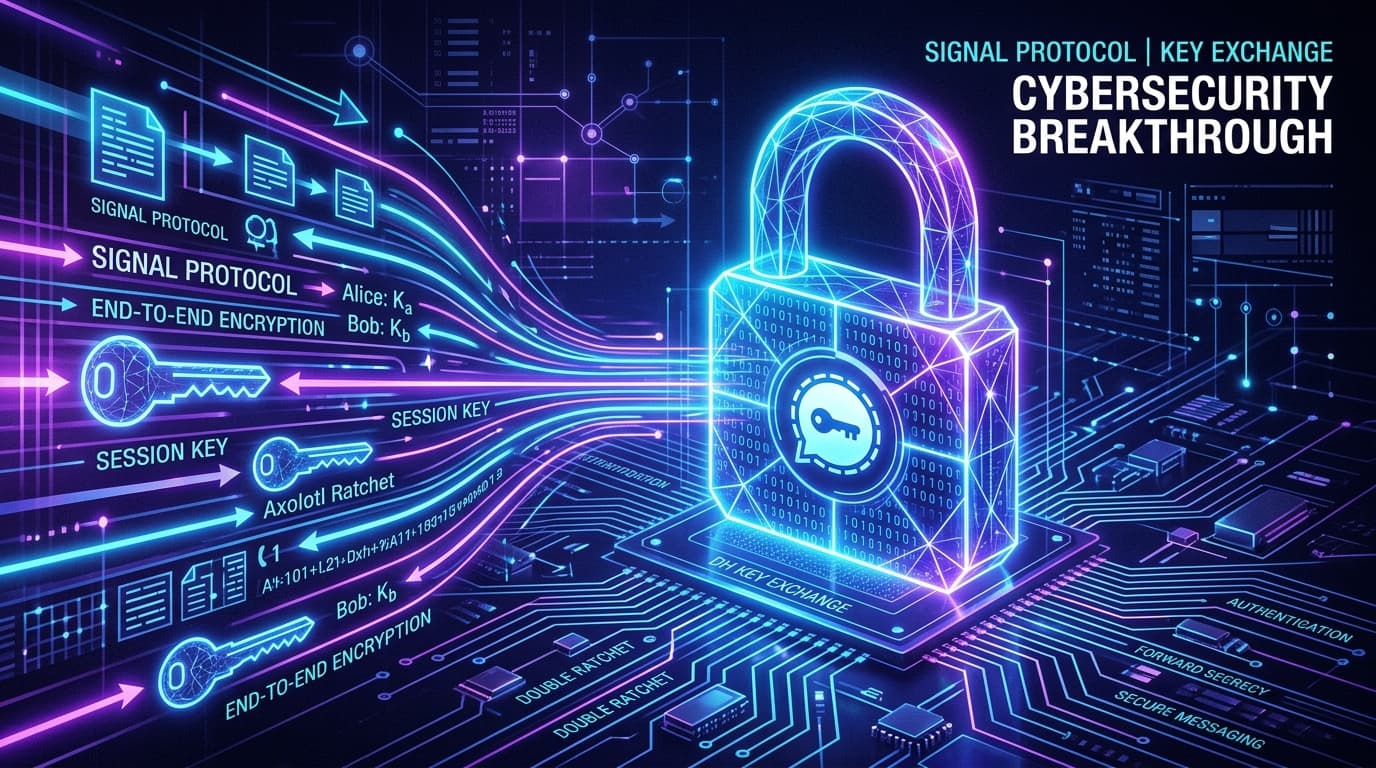

Post-Quantum Readiness: Why 2026 Is Your Deadline for Quantum-Safe Encryption
By Vinay Sharma

The Quantum Clock Is Ticking: Why 2026 Is Your Deadline for Post-Quantum Readiness
Quantum computers capable of breaking today's encryption don't exist yet. But the data you're protecting today — trade secrets, customer records, health information, financial data — may need to remain confidential for 10, 20, or 30 years. Adversaries know this. The strategy is called "harvest now, decrypt later": capture encrypted data today and store it until a sufficiently powerful quantum computer can break the encryption.
This isn't theoretical. Nation-state actors are already stockpiling encrypted traffic. The National Institute of Standards and Technology (NIST) finalized its first post-quantum cryptographic standards in 2024. Major regulators are signaling compliance timelines. 2026 is when enterprises must have a migration plan in place — not when migration should be complete, but when delay becomes indefensible.
What Quantum Computing Breaks
The Vulnerable Algorithms
Current public-key cryptography relies on mathematical problems that are hard for classical computers but trivially solvable by sufficiently powerful quantum computers:
- RSA: Based on integer factorization. Shor's algorithm on a quantum computer solves this exponentially faster.
- ECC (Elliptic Curve Cryptography): Based on the discrete logarithm problem. Also vulnerable to Shor's algorithm.
- Diffie-Hellman key exchange: Same vulnerability as RSA and ECC.
These algorithms protect virtually everything: TLS/HTTPS connections, VPNs, email encryption, digital signatures, software updates, authentication tokens, and blockchain transactions.
What Remains Safe
Symmetric encryption algorithms (AES-256) and hash functions (SHA-256, SHA-3) are considered quantum-resistant with sufficiently large key sizes. Grover's algorithm gives quantum computers a quadratic speedup against these, which is addressed by doubling the key length — feasible and already standard practice.
The urgent risk is asymmetric cryptography — and it is embedded in nearly every system you operate.
NIST Post-Quantum Standards: What You Need to Know
In 2024, NIST released the first finalized post-quantum cryptographic standards:
| Standard | Type | Use Case | Based On |
|---|---|---|---|
| ML-KEM (FIPS 203) | Key Encapsulation | TLS, VPN, secure messaging | CRYSTALS-Kyber (lattice-based) |
| ML-DSA (FIPS 204) | Digital Signature | Code signing, certificates, authentication | CRYSTALS-Dilithium (lattice-based) |
| SLH-DSA (FIPS 205) | Digital Signature | Stateless hash-based signatures (backup) | SPHINCS+ (hash-based) |
These standards are designed to be resistant to both classical and quantum attacks. They use mathematical structures (lattice problems, hash functions) for which no efficient quantum algorithm is known.
The "Harvest Now, Decrypt Later" Threat
This attack model is critical to understanding the urgency:
- An adversary captures your encrypted network traffic today
- The data is stored until quantum computers mature — potentially 5–15 years
- The adversary then decrypts the entire archive using quantum algorithms
Any data that must remain confidential beyond the expected timeline for cryptographically relevant quantum computers is at risk right now. This includes:
- Patient health records (HIPAA requires protection indefinitely)
- Financial records and trade secrets
- Government classified information
- Intellectual property and R&D data
- Long-term contracts and legal documents
Even if a full transition takes years, starting now protects data encrypted from this point forward.
Building Your Post-Quantum Migration Plan
Phase 1: Cryptographic Discovery (Months 1–3)
You cannot migrate what you don't know about. Conduct a comprehensive inventory:
- Identify all cryptographic assets: TLS certificates, SSH keys, VPN configurations, code signing certificates, API authentication, database encryption, file encryption
- Map algorithm usage: Which algorithms are used where? RSA-2048 for TLS? ECDSA for code signing? Diffie-Hellman for VPN?
- Assess data sensitivity and lifespan: Which data requires protection for 5+ years? 10+ years? This determines migration priority.
- Document third-party dependencies: Which vendors, SaaS platforms, and partners handle your cryptographic operations? What are their PQC timelines?
Phase 2: Risk Assessment and Prioritization (Months 3–5)
Not everything needs to migrate at once. Prioritize based on:
- Data longevity: Long-lived secrets first (medical records, IP, government data)
- Exposure surface: Internet-facing systems first (TLS, email, VPN), then internal systems
- Regulatory requirements: Industries with explicit PQC guidance (finance, healthcare, defense) have shorter timelines
- Vendor readiness: Prioritize systems where PQC-compatible upgrades are already available
Phase 3: Hybrid Deployment (Months 5–12)
The industry consensus is to deploy hybrid cryptography as the transition mechanism:
- Hybrid TLS: Connections use both a classical algorithm (e.g., ECDH) and a post-quantum algorithm (e.g., ML-KEM) simultaneously. If either algorithm is broken, the other provides protection.
- Hybrid signatures: Code signing and certificates use dual signatures — one classical, one post-quantum — ensuring backward compatibility while providing quantum resistance.
- Crypto-agility layers: Abstract cryptographic operations behind interfaces that allow algorithm swaps without application changes. This is the most important long-term investment.
Major platforms are already shipping hybrid support: Chrome and Firefox support hybrid TLS, AWS and Azure offer PQC options for key management, and Signal has deployed post-quantum key exchange.
Phase 4: Full Migration and Validation (Months 12–24)
- Transition from hybrid to pure PQC algorithms as ecosystem support matures
- Validate performance (PQC algorithms have larger key sizes and signatures — test for latency and bandwidth impact)
- Update compliance documentation and audit evidence
- Establish ongoing cryptographic monitoring to detect algorithm deprecation and new vulnerabilities
Common Objections — And Why They Don't Hold Up
"Quantum computers are decades away." Possibly. But NIST, NSA, CISA, and major financial regulators disagree on the timeline being that comfortable. The harvest-now-decrypt-later threat exists today, and the migration itself takes years. Starting late is not a viable strategy.
"We'll wait until our vendors handle it." Your vendors are planning their migrations now — and they'll need you to upgrade on your end. Crypto-agility work on your side reduces the risk of being blocked by a vendor's timeline.
"The performance overhead is too high." PQC algorithms do have larger keys and signatures. ML-KEM key exchange adds roughly 1KB to TLS handshakes. In practice, the latency impact is negligible for most applications. Test and measure — don't assume.
How ImpacttX Prepares Your Enterprise
ImpacttX Technologies provides end-to-end post-quantum readiness services: cryptographic discovery and inventory, risk-prioritized migration planning, hybrid deployment engineering, and crypto-agility framework implementation. We work with your security, infrastructure, and development teams to build a transition plan that protects your data today while preparing your systems for the quantum future.
Frequently Asked Questions
Does post-quantum migration require replacing hardware?
In most cases, no. PQC is a software-level change — algorithm updates, certificate rotations, and protocol upgrades. Some HSM (Hardware Security Module) devices may need firmware updates or replacement if they don't support the new algorithms, but general-purpose infrastructure is unaffected.
Are post-quantum algorithms proven secure?
The NIST-standardized algorithms have survived years of public cryptanalysis by the global research community. No practical attacks have been found. However, cryptography is always an evolving field — which is why crypto-agility (the ability to swap algorithms without re-engineering systems) is a critical design principle.
What's the cost of a PQC migration?
It varies by organization size and complexity. Discovery and planning typically costs $50K–$200K for mid-sized enterprises. Implementation costs depend on the number of systems and cryptographic touchpoints. The cost of not migrating — a retrospective data breach affecting years of archived data — is orders of magnitude higher.
Building something in security?
Our QA & Testing team ships production-grade systems like this. Free 30-min consultation.
Subscribe
Get our best insights in your inbox
Practical guides on AI, cloud, security, and marketing. No spam, unsubscribe in one click.