
How to Do Digital Marketing for Web Apps — and Why You Should Start in Engineering
By Pratibha Jaglan
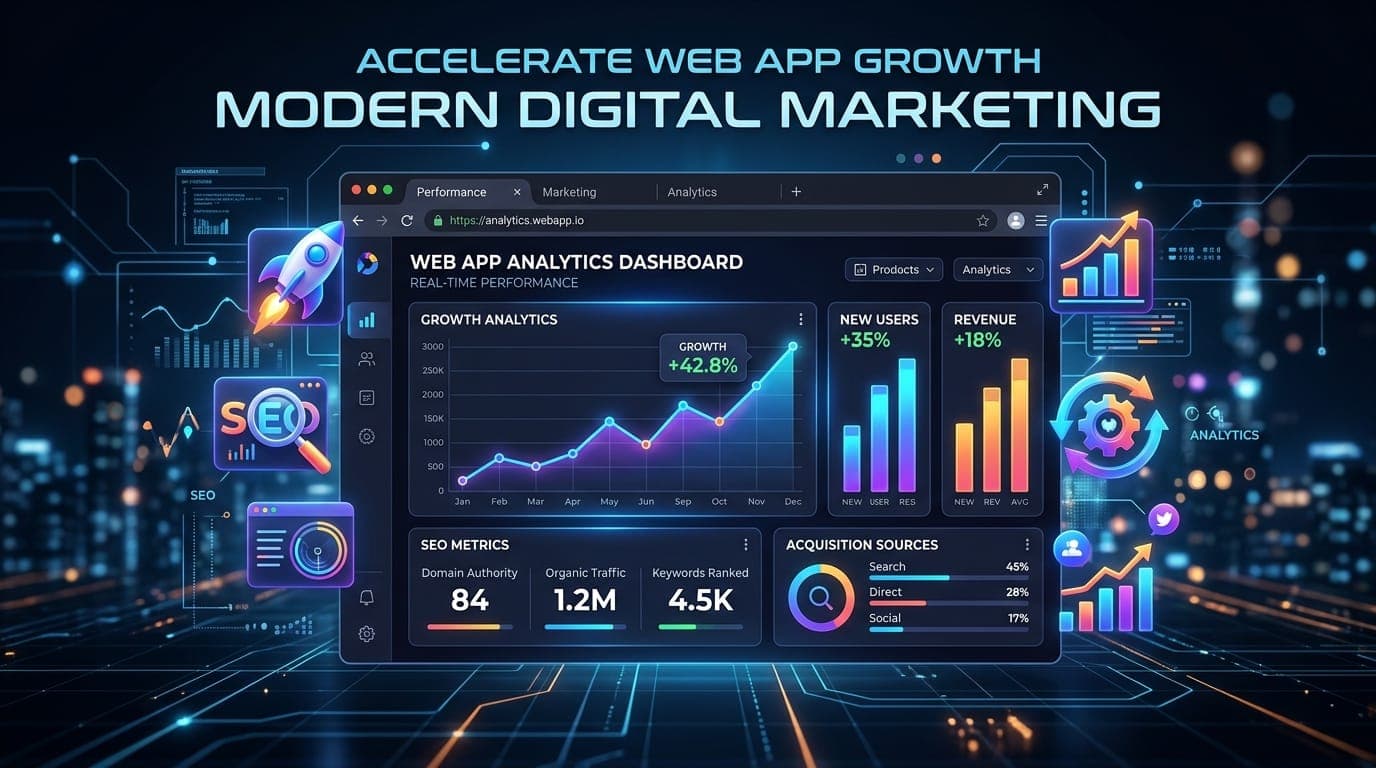
A web app that nobody finds is a project, not a product. Yet most engineering teams treat "marketing" as the thing that happens after launch — by which point the website has been built in a way that makes marketing it structurally hard. This post is the reverse: how to design, build, and grow a web app with marketing baked in from day one, and why doing it later costs 5–10× more.
This is the playbook we run with clients. It's pragmatic, not theoretical — every section maps to a task you can ship this sprint.
1. Why Marketing Belongs in the Engineering Roadmap
The default engineering view of "marketing" is a landing page and some ads. That misses the real leverage. Modern web-app marketing is 70% technical decisions made in code:
- Crawlability — can Google read your SPA?
- Performance — Core Web Vitals are a ranking factor.
- Site architecture — URL structure, internal linking, canonicalization.
- Schema — structured data that earns rich results.
- Tracking — measurement that survives ITP, ATT, and consent banners.
- Lifecycle — email and in-product surfaces that compound.
If these are retrofitted after launch, you'll spend a quarter rebuilding routes, restructuring components, and re-instrumenting analytics. Build them in from day one and they cost almost nothing.
2. SEO for Web Apps: The Hard Part
Single-page apps (SPAs) have a tortured relationship with SEO. The browser executes JavaScript, fetches data, renders — then a crawler arrives, sees an empty <div id="root">, and leaves. For years, the advice was "just use SSR." That's still mostly true, but the nuance matters in 2026.
The crawlability spectrum
| Architecture | Crawlability | SEO rating | Effort |
|---|---|---|---|
| Pure CSR (Vite SPA) | Poor — relies on JS execution | Weak | Low |
| SSR (Next.js / Nuxt) | Excellent — HTML on first byte | Strong | Medium |
| SSG (Next.js static) | Excellent — pre-rendered HTML | Strongest for content | Medium |
| ISR (Next.js on-demand) | Excellent + fresh | Strong | Medium |
| Edge-rendered | Excellent | Strong | Medium |
Rule of thumb: every public-facing, content-bearing route should return semantic HTML on first byte. Authenticated app routes can stay CSR — they're not for crawlers anyway.
What "semantic HTML" really means
- One
<h1>per page, content-rich<h2>s underneath, logical document order. - Real
<a href>links to internal pages — not<button onClick>navigations. - Descriptive
<title>,<meta description>, canonical URL, Open Graph, and Twitter card on every route. - JSON-LD structured data for the entity type (
Article,Product,FAQPage,Organization).
The Next.js pattern that scales
// app/blog/[slug]/page.tsx
import type { Metadata } from "next";

export async function generateMetadata({
  params,
}: {
  params: Promise<{ slug: string }>;
}): Promise<Metadata> {
  const { slug } = await params;
  const post = await getPost(slug);
  return {
    title: post.title,
    description: post.description,
    alternates: { canonical: `${siteUrl}/blog/${slug}` },
    openGraph: { type: "article", title: post.title, images: [post.ogImage] },
    twitter: { card: "summary_large_image" },
  };
}

export default async function PostPage({ params }) {
  const post = await getPost(await params.slug);
  const jsonLd = {
    "@context": "https://schema.org",
    "@type": "BlogPosting",
    headline: post.title,
    author: { "@type": "Person", name: post.author },
    datePublished: post.date,
  };
  return (
    <article>
      <script
        type="application/ld+json"
        dangerouslySetInnerHTML={{ __html: JSON.stringify(jsonLd) }}
      />
      <h1>{post.title}</h1>
      <PostContent />
    </article>
  );
}
Three lines you should never ship without: title, description, canonical. The three most common reasons pages don't rank.
3. Core Web Vitals — The Ranking Factor You Can't Ignore
Google's Core Web Vitals are real ranking signals. They're also user-experience signals — improving them improves conversion.
| Metric | Target | What it measures | How to fix |
|---|---|---|---|
| LCP (Largest Contentful Paint) | < 2.5s | Perceived load speed | Optimize hero image, font loading, server response |
| INP (Interaction to Next Paint) | < 200ms | Responsiveness | Reduce JS, defer non-critical work, avoid main-thread blocking |
| CLS (Cumulative Layout Shift) | < 0.1 | Visual stability | Reserve space for images/ads, avoid dynamic injection above the fold |
Quick wins that move all three
- Self-host fonts. Google Fonts adds a DNS lookup, a connection, and a request. Self-hosted woff2 with
font-display: swapis 200ms faster. - Image strategy: AVIF/WebP with
<picture>+ explicitwidth/heightattributes. Use Next.js<Image>or Astro's built-in optimizer. - Defer third-party scripts. Analytics, chat widgets, and tag managers belong in
next/scriptwithstrategy="afterInteractive"orlazyOnload. They should never block first paint. - Code-split routes. Every route ships only the JS it needs. Next.js App Router does this by default; in Vite, use
React.lazyaggressively. - Edge rendering for content. Move static and ISR pages to the edge. The 50ms TTFB matters more than you think.
4. Content Strategy — The Compounding Asset
SEO without content is a fridge with no food. You can rank a feature page for "[product] pricing," but you'll only rank for "[industry] best practices" if you write it.
The content portfolio
- Pillar pages (1,500–3,000 words): comprehensive guides around your core topic. These become the pages other sites link to.
- Cluster pages (800–1,500 words): specific subtopics that link back to the pillar. Internal linking is what makes the cluster work.
- Product/feature pages (300–800 words): sales-focused, optimized for bottom-funnel intent ("hire X agency", "buy Y tool").
- Comparison pages: "[your product] vs [competitor]", "best [category] alternatives." These capture high-intent commercial searches.
- Case studies: real numbers, real outcomes. The single most undervalued content type in B2B.
The 80/20 of content velocity
One pillar + four cluster articles per month, for 6 months, will outperform almost any other marketing investment. The constraint is never "ideas" — it's consistency. Use a calendar, write to brief, ship weekly.
5. Technical SEO Checklist (the non-negotiables)
sitemap.xmlgenerated from your routes, submitted to Google Search Console and Bing Webmaster.robots.txtwith explicitAllow/Disallowrules and a sitemap reference.- Canonical URLs on every page — even if you don't think you have duplicates, parameter URLs will create them.
- Redirects: 301 for permanent moves, 308 if you change methods. Never use 302 for content migrations.
hreflangtags if you serve multiple locales.- HTTPS with HSTS, modern TLS, and a valid certificate. No mixed content, ever.
- Structured data validated in Search Console's Rich Results test.
- Open Graph + Twitter Card images per page — they're what people click on social.
6. Paid Acquisition — How It Actually Works for Web Apps
Paid media for web apps is very different from e-commerce. You're not converting on first click; you're starting a relationship.
The funnel that converts
- Top of funnel — educational content (your pillar pages) + LinkedIn/YouTube ads targeting job titles. Goal: low-cost visits, retargeting pixels.
- Mid funnel — case studies, comparison pages, lead magnets. Goal: capture email, start nurture.
- Bottom of funnel — branded search, demo/CTA pages, free trial. Goal: conversion.
The mistake most teams make is running bottom-funnel ads to cold audiences and burning budget. The fix: spend 60% of budget on top/mid funnel content, then retarget the warm audience with direct-response offers.
Tracking that survives 2026 privacy rules
- Server-side tagging (GTM SS) — sends events from your server to GA4 / Ads, sidestepping ITP and ad blockers.
- Consent Mode v2 — Google's framework for handling consent without losing measurement.
- Enhanced Conversions — hashed email/phone sent with conversion events, dramatically improving match rate.
- First-party data — your own CRM is the highest-quality audience you'll ever have. Use it for lookalikes and remarketing.
7. Lifecycle — The Compounding Channel
Email and in-product messaging are the only channels you actually own. SEO can be algorithm-penalized; ads can be repriced overnight; social platforms change algorithms constantly. Email keeps compounding.
The 5-email onboarding sequence that works
- Welcome (immediately) — confirm value prop, set expectations.
- Day 1 — first success moment. Get them to the "aha" fast.
- Day 3 — second feature, tied to their use case.
- Day 7 — case study or social proof.
- Day 14 — conversion nudge (upgrade, demo, call).
Send it via your transactional provider (SendGrid, Postmark, Resend) — not your marketing ESP — for deliverability. Triggered, behavior-based emails outperform broadcast emails 5–10×.
8. Analytics That Tell You the Truth
Most web-app analytics setups are vanity dashboards. Fix yours with these principles:
- One source of truth. Pick GA4 + BigQuery, or PostHog, or Plausible + a custom events table. Don't run three half-configured tools.
- Track outcomes, not vanity. Pageviews are noise. Sign-ups, demo requests, paid conversions, retention cohorts are signal.
- Server-side events for anything that matters. Client-side events miss 15–40% of conversions due to ad blockers and ITP.
- UTM discipline. Document your UTM convention and enforce it. Without naming conventions, your reports are garbage in, garbage out.
- Quarterly attribution review. Channels drift. What worked last quarter may not this one.
9. The Marketing-Engineering Loop
The fastest-growing web apps we work with run a tight loop:
- Engineering ships instrumented features (events, UTM handling, server-side tracking).
- Marketing runs experiments against specific cohorts.
- Analytics reveals what works.
- Engineering doubles down on what works.
- Repeat weekly.
If marketing files a ticket "we need to track X" and engineering estimates it as a 3-month P3, this loop never starts. Make marketing instrumentation a first-class engineering priority — same sprint, same priority queue as features.
10. Why You Should Do This (And Do It Now)
The case for web-app marketing baked into engineering, in three numbers:
- 3× — 5×: the multiplier on organic traffic 12 months after a proper SSR + content engine ships.
- 30% — 50%: the typical reduction in paid CAC when retargeting is built on a real content audience.
- 12–18 months: the lead time for SEO compounding to really show up. Start now or start later — but later is always more expensive.
If you launched without these and you're reading this thinking "we should fix it," the good news is most of it is a 1–2 quarter engineering project, not a rewrite. The bad news is every month you wait is a month your competitors are compounding.
Need a marketing engine for your web app?
We combine technical SEO, paid media, and lifecycle automation into a single growth engine. Tell us your goals — we'll share a 90-day plan in 24 hours.
Building something in digital marketing?
Our Digital Marketing team ships production-grade systems like this. Free 30-min consultation.
Subscribe
Get our best insights in your inbox
Practical guides on AI, cloud, security, and marketing. No spam, unsubscribe in one click.